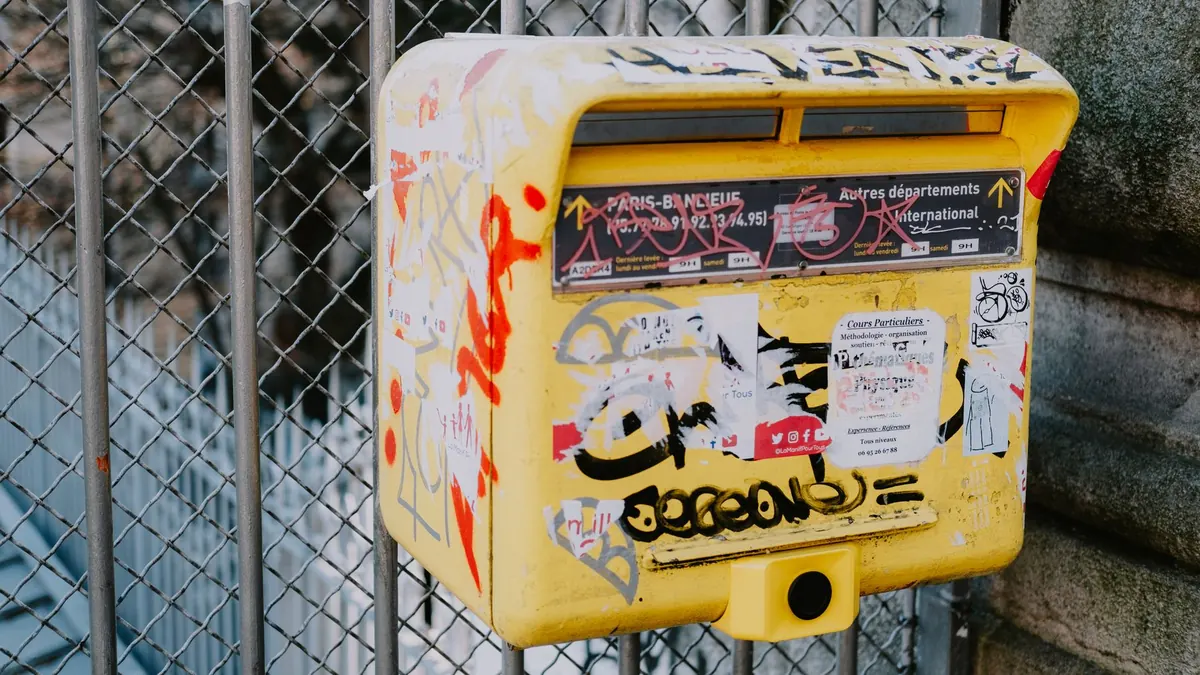
Colour is a decision, not an accident. Some of Britain's earliest roadside letter boxes were green, chosen to sit quietly against hedges and brickwork. Red arrived later in the nineteenth century and had become the standard by the 1870s, largely because a postbox you cannot see from a passing carriage is a postbox that fails at its job. Other countries made other choices: France and Germany went yellow, the United States blue.
Gold, then, is a deliberate exception. It says something happened here. The gold coat goes onto the outside of a working object, so the box keeps collecting letters while it carries the message. It behaves a little like a blue plaque, except that you can post a birthday card in it.
The modern gold postbox starts with the London 2012 Olympic and Paralympic Games. Royal Mail painted a postbox gold for each of the British gold medallists, sited in or near the winner's home town. More than a hundred boxes were repainted, in cities, market towns, suburbs and villages. Each was a small public monument to a local name, and many were given a plaque recording the athlete and the event.
Royal Mail said the boxes would stay gold, and most of them have. That is what makes them worth seeking out: they are not temporary decorations but permanent alterations to the street furniture of the country.
The scale of the programme is easy to underestimate. Team GB and ParalympicsGB won gold across dozens of disciplines, from rowing and cycling to equestrianism, sailing and athletics, so the gold boxes ended up scattered across the whole country rather than clustered in the big cities. A small village in Scotland, a suburb of Cardiff and a coastal town in Cornwall could each find themselves with a monument overnight. In some places the repainting happened within days of the medal ceremony, and photographs from the time show the painter at work with locals gathered around, which is part of why people feel a stake in them.
Because the boxes are chosen for location rather than merit, they are wonderfully inconsistent. Two gold boxes might stand a few miles apart and look nothing alike: one a tall Victorian pillar box with fluting and a royal cypher, the other a squat lamp box bolted to a metal post. Some carry neat brass-style plaques; others have weathered signs that have been replaced or, in a few cases, stolen. A handful have been repainted after damage or vandalism, and a small number have disappeared entirely when the site was redeveloped or the box was removed from service.
They are not all grand Victorian pillar boxes. The programme reached whatever box happened to stand closest to the relevant street, so the collection includes wall boxes set into garden walls, small lamp boxes on posts, and pillar boxes in busy shopping streets. Two of the best known are in Dunblane, honouring Andy Murray, and in Sheffield, where the box painted for Jessica Ennis is still photographed daily.
Others have become local landmarks in their own right: boxes in cycling towns, in rowing villages on the Thames, and in northern towns where a Paralympic gold was the proudest thing to happen that decade. Some councils have quietly adopted their boxes, repainting them when the weather gets to them and even adding flowers or bunting on anniversaries. In a few places, a second box in the same town has been painted to mark a later achievement, so you occasionally find two gold boxes within a short walk of each other.
2012 is not the only reason a box might gleam. Other postal operators have marked their own athletes and anniversaries with gold paint, and a handful of boxes have been repainted locally for a village celebration or a centenary. There have also been one-off gold boxes painted to salute later successes, such as British golds at subsequent Games or major sporting victories, so the 2012 set is the largest but not the final word. If a box is gold and the plaque mentions a name you don't recognise, it is worth reading closely before assuming it belongs to the Olympic programme.
It also pays to check what you are looking at. Plenty of objects look like postboxes without being part of the network: private boxes outside offices, decorative replicas, museum pieces, boxes on private land. If it has no collection plate and no cypher, it probably is not a Royal Mail box, however gold it is.
There is no official national map, but the boxes are well documented by the people who live near them. A few approaches that work:
A little patience goes a long way. Gold boxes are rarely signposted from the main road, and the pleasure of finding one is partly the pleasure of noticing something a map would never show you.
Strip away the novelty and a gold postbox is a strange, rather brilliant idea. It takes an ordinary piece of national infrastructure and hands it over, briefly, to a single person and the place that made them. Most monuments are statues of people long dead, paid for by committees and unveiled by mayors. A gold postbox is the opposite: it is cheap, it is useful, and it belongs to someone who is probably still alive and might well walk past it.
It also reveals something about how the country marks achievement. Britain has never been especially comfortable with grand monuments to living people, but it has always been good at small, practical tributes: a plaque on a wall, a bench with a name on it, a tree planted in a park. The gold postbox fits that tradition exactly. It is modest, humorous and permanent all at once.
So the next time one catches your eye, cross the road. Read the plaque, work out which event it celebrates, and enjoy the fact that you are standing at a crossroads of local pride and national infrastructure. Then, if you happen to have a letter on you, post it. The box is still doing its day job, and that is exactly the point.
Photo: Mathias Reding / Pexels