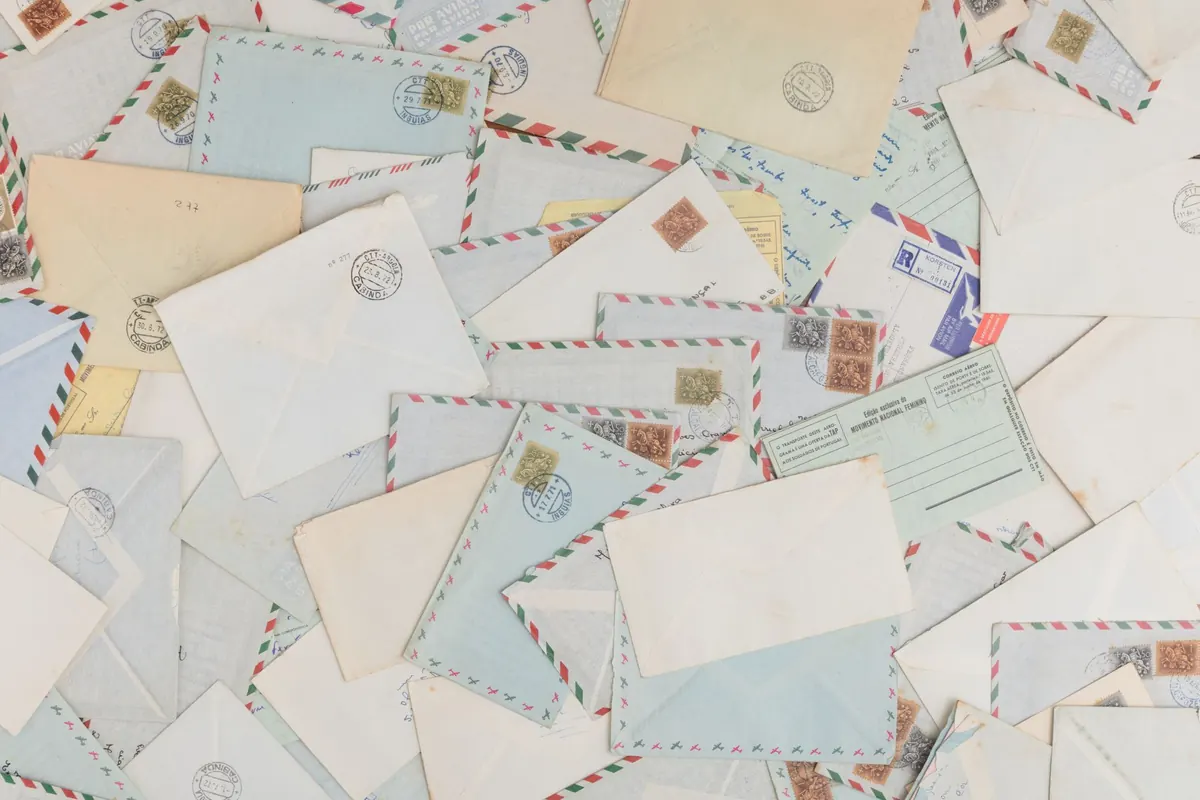
A single old envelope can carry half a dozen small, deliberate marks. Someone struck them by hand at a post office counter, or a machine rolled them on somewhere between two railway stations. Each one records a decision: when the letter was accepted, where it entered the mail, how it was sorted, and what it cost. Learn to read those marks and a plain cover turns into a document.
This is a beginner's tour of what to look for, in roughly the order you should look for it.
A cancellation exists to deface the stamp. Once the stamp is marked, it cannot be peeled off and reused. A postmark is the recording device: it states where and when the item was handled. Frequently the same strike does both jobs.
But not always. When Britain introduced the Penny Black in 1840, the stamps were cancelled with a distinctive cross-shaped obliterator, and the date information was applied separately, often on the back. Two markings, two purposes, one cover. Collectors use the word "postmark" loosely for all of it, and that is fine in conversation. When you are describing a cover to a dealer or in a catalogue listing, be precise about which mark you mean.
The classic handstamp is a circle or oval containing several separate pieces of information, and every piece is worth reading.
Read a strike the way you read a coin: start at the outside and work inwards. Missing digits are normal. A partial strike that gives you the month and the town is still useful evidence.
The shape of a handstamp narrows down the period and the country faster than almost anything else. Circles, ovals, rectangles, shields, hexagons and the British "squared circle" all belong to particular fashions in postal equipment, and post offices changed their stock slowly.
Barred numerals deserve special attention. From 1844, British post towns were allocated numbers, and the number was struck inside a grid of bars to cancel the stamp. A cover with a clean "447" is telling you which town handled it, even if the dated part of the strike is weak. Where a dated stamp and a barred killer sit on the same device, you have a duplex cancellation, common on later Victorian and Edwardian mail.
Ink colour carries meaning too. Black is the everyday default. Other colours were used by particular offices, for particular services, or simply because that was the pad on the counter, so treat an unusual colour as a question to investigate rather than proof of anything.
Once sorting machines arrived, the postmark gained a second job: advertising. A slogan is a postmark with a message beside it, urging the public to post early for Christmas, support a health campaign, or visit an exhibition. Because slogans ran for limited periods, a dated slogan can pin a cover to a fairly tight window, which makes them genuinely useful for dating undated correspondence.
Machine cancels often leave wavy lines rather than bars. The American "flag" cancels, with a flag design worked into the killer, are a collecting field of their own. When a slogan refers to a specific event, treat that reference as a clue with a range, not a single date.
These are the marks that explain what happened to the letter rather than when it was posted, and beginners tend to overlook them.
Step six is the one people skip, and it is the one that teaches you most. If you look up the answer first, you tend to see what the book told you to see.
Learn on common material. Cheap covers from large offices are plentiful, well documented and forgiving of mistakes. Build a small reference set of your own: a dozen covers you understand completely, kept together, so you can compare an unknown strike against a known one.
For identification, general stamp catalogues cover the basics, and specialist societies publish handbooks and postmark studies by county, country and period. Local and national postal history societies are excellent value, and their members will often date a strike for you from a scan.
One last caution: age and rarity are different things. A cover from 1905 with a heavy, common office strike is not scarce, while a faint impression from a small village office that closed after two years can be genuinely hard to find. Before you spend serious money on an unusual marking, get a second opinion. Reading postmarks is a skill built by repetition, and every cover you examine carefully makes the next one easier.
Photo: craveiro_ pics / Pexels